

How Gravel and Geotextiles Prevent Settling in Large Commercial Site Development
March 10, 2026
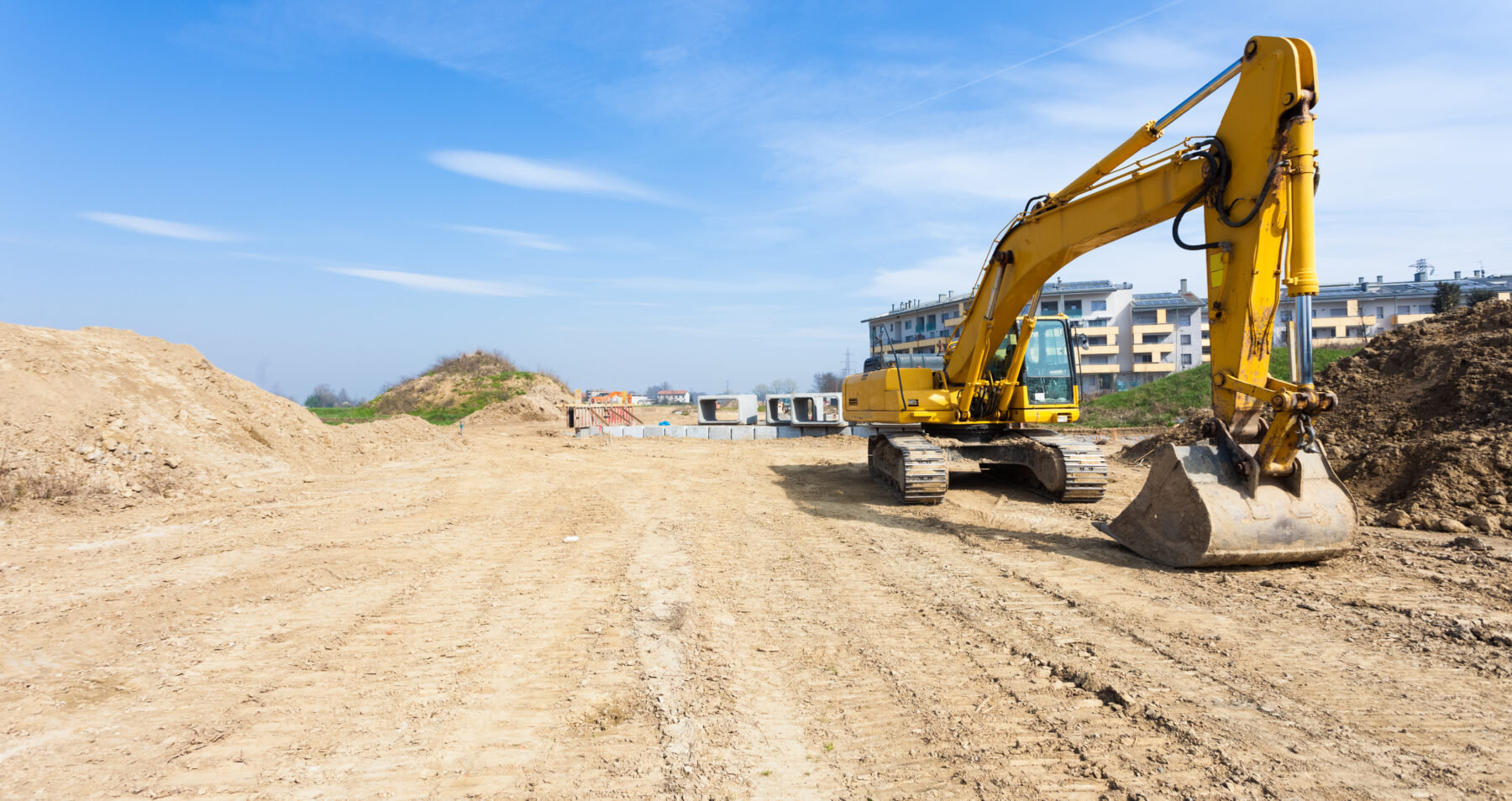
Structural load transfer begins at the soil interface, not at the slab. Truck traffic, equipment staging, foundation weight, and paved surfaces all impose sustained pressure on subgrade layers that may lack the strength or stability to carry it. In large commercial site development, settlement rarely announces itself dramatically. Instead, it emerges gradually by way of uneven slabs, cracked pavement, and shifting curbs that disrupt operations and accelerate repair cycles.
Controlling settlement starts below the surface, where aggregate structure and soil stabilization methods work together to manage load distribution. Gravel and geotextiles form a structural system that reinforces subgrade conditions, limits soil migration, and maintains surface stability under repeated loading cycles. Their role is mechanical, calculated, and essential to protecting the investment above.
Understanding How Settlement Begins
Moisture movement, soil composition, and compaction levels determine how subgrade reacts under pressure. Fine-grained soils such as silts and clays tend to shift when exposed to water, losing internal friction and reducing their ability to support concentrated loads. Without intervention, that instability travels upward, affecting base layers and surface materials. Heavy equipment intensifies this effect during construction. Repeated passes compress some areas more than others, creating inconsistencies in density. Once paving or slabs are placed over uneven support conditions, differential settlement becomes a matter of time and loading cycles. That reality is why subgrade preparation cannot rely on compaction alone. Soil structure must be reinforced and separated in a way that maintains consistent bearing capacity across the entire footprint of the project.
The Structural Role of Gravel in Load Distribution
Angular gravel creates interlock. Each stone resists movement by bearing against adjacent particles, forming a stable matrix that spreads vertical loads outward rather than allowing them to concentrate in one location. That redistribution reduces point pressure on weaker soils below.
Gravel selection is very important at this stage. Gradation, particle shape, and depth of placement determine how effectively loads transfer through the layer. A well-graded aggregate base fills voids while maintaining internal drainage paths, limiting water buildup that can weaken the subgrade beneath. Compaction of the aggregate layer further increases internal density; tightening particle contact and reducing future movement. When properly placed and compacted, gravel becomes more than a base layer. It functions as a structural platform capable of supporting foundations, parking lots, loading docks, and heavy-traffic access roads.
Where Geotextiles Change the Equation
Soil migration is one of the most common causes of settlement in large commercial sites. Fine particles move upward into aggregate layers under traffic vibration and moisture cycling, gradually reducing stone interlock. That blending weakens the base and creates voids below. Geotextiles act as a separation barrier between subgrade soil and aggregate. The fabric permits water to pass through while preventing fine soil particles from entering the gravel layer. This separation preserves aggregate structure and maintains consistent load distribution across the site. Tensile strength within the geotextile also contributes to stability. When placed beneath gravel, the fabric absorbs and redistributes stress, reducing rutting and limiting lateral movement. In soft soil conditions, this reinforcement effect increases the structural capacity of the entire system without requiring excessive excavation depth.
Building a Reinforced Base System
Placement sequence determines how well gravel and geotextiles perform together. After subgrade grading and proof rolling, the geotextile is laid directly over the prepared soil, ensuring full contact without wrinkles or folds. Overlapping seams according to project specifications prevents weak points that could allow soil intrusion. Aggregate is then placed in controlled lifts, minimizing direct equipment contact with the exposed fabric. Spreading methods and lift thickness are coordinated to prevent displacement of the geotextile beneath. Compaction follows, locking the gravel matrix into place and activating the reinforcement behavior of the system.
Drainage considerations also factor into this assembly. Proper grading and edge containment direct water away from structural zones, preserving internal density and reducing moisture-driven settlement. Each layer works in coordination with the next, forming a unified support structure rather than independent materials stacked on soil.
Protecting Pavement and Foundation Investment
Surface cracking often traces back to what lies below. When settlement occurs unevenly, rigid pavement and slab systems absorb stress they were not intended to carry. The visible damage becomes the symptom of insufficient ground stabilization. By combining angular gravel with engineered geotextiles, commercial developments establish a consistent bearing platform before vertical construction begins. The aggregate spreads load, the fabric maintains separation and reinforcement, and the subgrade remains protected from particle migration and moisture-related softening.
Large commercial sites demand predictable surfac